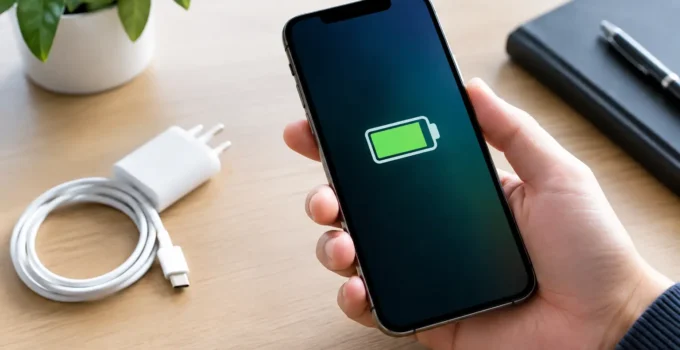
Your phone once made it through a full day without much thought. Now it reaches 20% before dinner, gets warm while charging, or suddenly drops from 15% to 5%. Those are common signs that battery health may be declining – but they do not always mean you need a new phone.
Phone batteries are consumable parts. Every iPhone, Samsung Galaxy, Google Pixel, and Android device uses a lithium-ion battery that gradually holds less energy as it ages. The goal is not to keep it at 100% health forever. That is impossible. The practical goal is to slow unnecessary wear, recognize when a problem is more than normal aging, and know when a battery replacement makes better sense than replacing the whole device.
What Battery Health Actually Means
Battery health describes how much charge your battery can store compared with when it was new. A battery rated at 100% capacity may eventually fall to 90%, then 80%, and lower. At 80% health, your phone can still work normally, but it has roughly 80% of its original usable capacity. In simple terms, you will need to charge it more often.
It is different from your current battery percentage. Your phone can show 100% charge while its long-term maximum capacity is only 82%. It is also different from battery life, which is the number of hours your phone lasts in a day. Battery life can be affected by screen brightness, mobile signal, background apps, software bugs, and the way you use the phone.
A healthy battery can still drain quickly if you spend hours recording video, navigating with GPS, or using 5G in an area with weak coverage. On the other hand, a worn battery may make ordinary daily use frustrating even with light use.
How to Check Battery Health on iPhone and Android
On an iPhone, open Settings, choose Battery, then select Battery Health & Charging. You will see Maximum Capacity, along with a message if the iPhone detects reduced performance or recommends service. Apple generally considers 80% capacity a point where a replacement may be worth considering, especially if the phone is no longer lasting through your normal day.
Android is less consistent because each manufacturer handles battery information differently. Samsung Galaxy owners can open the Samsung Members app and use Phone Diagnostics to check battery status. On Google Pixel phones, battery information is available through Settings, though the exact details can vary by Android version. Some Android brands provide a battery-health percentage, while others only show a general condition such as Normal or Good.
If your phone does not show a capacity estimate, watch for real-world symptoms instead. Repeated unexpected shutdowns, a major drop in daily runtime, overheating during basic tasks, or a swollen back panel deserve attention. A swollen battery is a safety issue. Stop using and charging the phone, and arrange professional service as soon as possible.
Do Not Obsess Over One Number
Battery capacity estimates are useful, but they are not laboratory measurements. The number may shift after a software update, a period of different charging habits, or the phone recalculates its estimate. A reading of 89% is not automatically bad, and 80% is not an emergency.
What matters most is whether the phone still fits your routine. If it lasts all day and performs normally, there is little reason to replace a battery simply because the percentage has fallen. If you carry a charger everywhere or the phone slows down under load, the same number becomes much more meaningful.
What Causes Battery Health to Decline
Charge cycles are the biggest unavoidable factor. A cycle is the equivalent of using 100% of your battery’s capacity, but it does not have to happen all at once. Using 50% one day and 50% the next equals one full cycle. More charging over time means more chemical aging.
Heat is the factor you can most often control. Lithium-ion batteries dislike high temperatures, particularly while charging. Leaving a phone on a hot car dashboard, charging it under a pillow, or playing demanding games while fast charging can add extra stress. If your phone becomes unusually hot, remove a thick case while charging and let it cool down before continuing.
Keeping a battery at very high or very low charge for long periods can also increase wear. That does not mean you should panic every time your phone reaches 100% or falls to 10%. Phones are built for everyday use. The concern is repeated extremes, such as leaving a phone drained for weeks or charging it at full capacity in a hot environment night after night.
Fast charging creates more heat than slower charging, but it is not automatically harmful. Modern phones manage charging speeds, temperature, and power delivery to reduce risk. Fast charging is useful when you need it. If you charge overnight or have plenty of time, slower charging may keep temperatures lower, especially in a warm room.
Battery Health Habits That Make a Real Difference
The most helpful habit is simple: keep your phone cool. Charge it on a hard, open surface, away from direct sunlight and bedding. If wireless charging makes your phone noticeably warmer than a wired charger, use wired charging more often. Wireless charging is convenient, but some phones produce more heat during it.
Use a reliable charger and cable that meet your phone’s requirements. Cheap, damaged, or poorly made charging accessories can create inconsistent charging and excess heat. You do not need to buy the phone maker’s most expensive accessory, but certified and reputable options are a safer choice.
Turn on built-in charging protections. iPhones offer Optimized Battery Charging and, on supported models, a charge limit option. Android phones may offer Adaptive Charging, Battery Protection, or a maximum charging limit, depending on the brand. These features learn your schedule or stop charging near 80% to reduce the time the battery sits at full charge.
An 80% limit is most useful for people who charge frequently at a desk, work from home, or plug in overnight every day. It is less practical before a long flight, a workday away from power, or any time you need maximum runtime. Battery care should support your life, not create another daily rule to manage.
Avoid making a habit of running the battery to 0%. Deep discharges are harder on lithium-ion batteries than smaller top-ups. Charging when you are around 20% to 40% is perfectly fine. The old advice to fully drain a phone before charging comes from older battery technologies and does not apply to modern smartphones.
Should You Close Apps to Save the Battery?
Usually, no. Constantly force-closing apps can make your phone use more power when those apps have to reload. Instead, check your battery usage screen to find apps that are genuinely consuming an unusual amount of power. A social app with heavy background activity, poor signal strength, location tracking, or a recent software bug is more likely to cause battery drain than normal multitasking.
If battery life suddenly gets worse after an update, give the phone a day or two to finish background tasks such as indexing photos and optimizing apps. If the problem continues, update your apps, restart the phone, and review which apps are at the top of the battery-use list.
When a Battery Replacement Is the Better Fix
A replacement is worth considering when your phone is otherwise in good condition but cannot reliably last through your day. It can also help if the device shuts down unexpectedly, shows a service warning, or feels slow because the system is managing performance around a degraded battery.
For a two- to four-year-old phone that still receives security updates and meets your needs, replacing the battery can be much cheaper and less wasteful than buying a new device. The trade-off is that repair quality matters. Use the manufacturer, an authorized provider, or a reputable repair shop that installs a quality battery and properly reseals the phone.
If your phone also has a cracked display, limited storage, poor camera performance, and no remaining software support, putting money into a battery may not be the best value. In that case, a newer phone can bring better efficiency, longer update support, and a fresh battery at the same time.
Battery aging is normal, not a personal failure. Keep the phone cool, use its charging protections when they suit your routine, and pay attention to how it performs rather than chasing a perfect percentage. When daily battery life stops working for you, that is the right time to act.