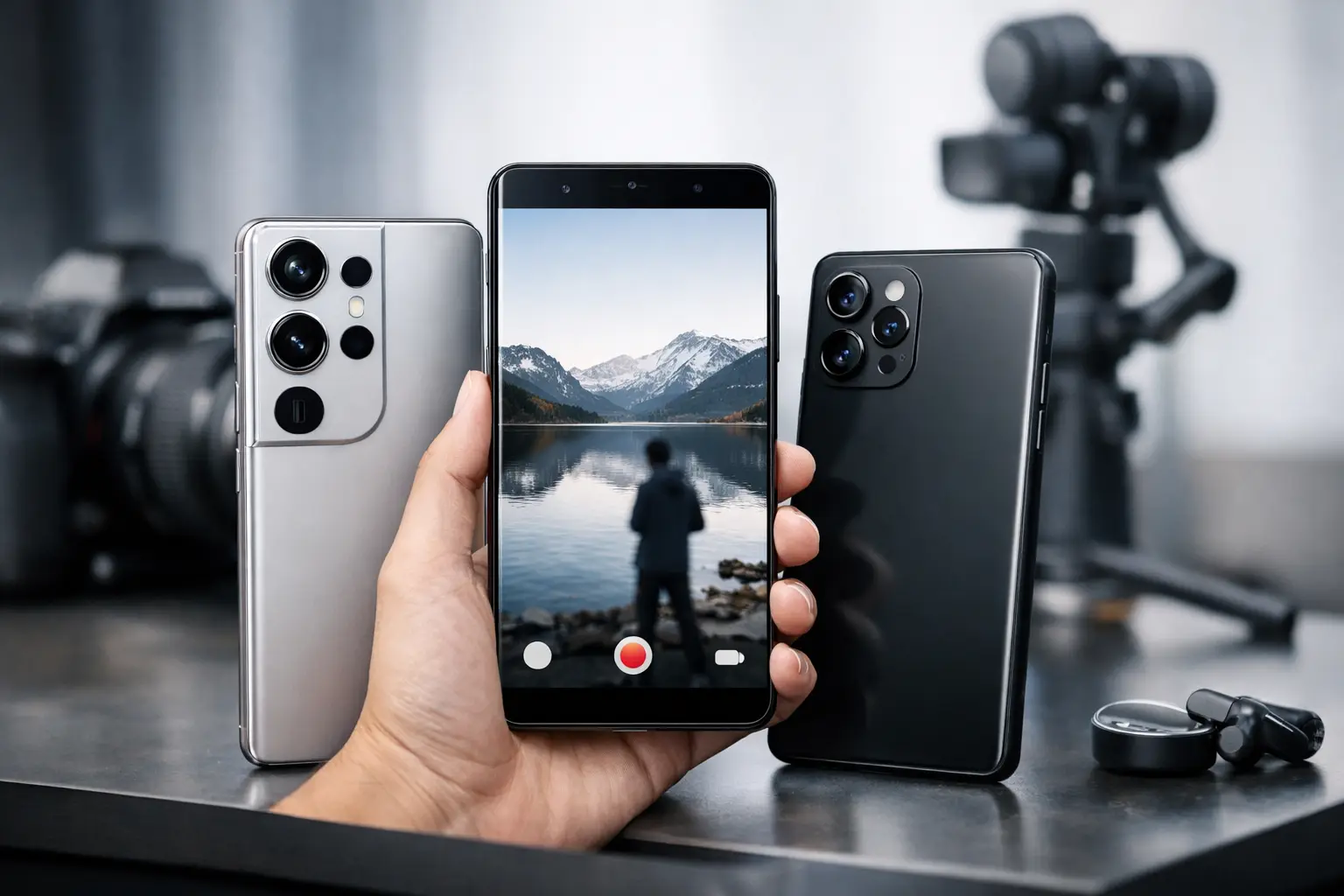
The best camera phones in late 2026 are the Samsung Galaxy S26 Ultra for zoom and all-round shooting, the iPhone 18 Pro and 18 Pro Max for video, the Google Pixel 11 Pro and 11 Pro XL for easy point-and-shoot photos, and the Xiaomi 17 Ultra for photo enthusiasts who can buy it where they live.
These picks are based on each maker’s published camera specs and features, linked in every section, plus what each brand’s camera software is known for. They are not the result of our own photo tests. Megapixels alone do not decide which phone takes better pictures, so the sections below explain who each phone suits.
Camera Specs at a Glance
| Phone | Main camera | Ultrawide | Telephoto | Top video |
|---|---|---|---|---|
| Samsung Galaxy S26 Ultra | 200MP, f/1.4 | 50MP, f/1.9 | 50MP 5x (f/2.9) + 10MP 3x (f/2.4); 10x optical quality | See Samsung’s specs |
| iPhone 18 Pro / 18 Pro Max | 48MP, variable aperture f/1.48 to f/4.0 | 48MP, f/2.2 | 48MP 4x (100 mm, f/2.8); 8x optical quality | 4K Dolby Vision up to 120 fps, ProRes RAW |
| Google Pixel 11 Pro / 11 Pro XL | 50MP, f/1.68, 1/1.3″ sensor | 48MP, f/1.7 | 48MP 5x (f/2.8) | 8K at 30 fps with Video Boost |
| Xiaomi 17 Ultra | 50MP, f/1.67, 1-inch sensor | 50MP, 14 mm | 200MP, 75 to 100 mm (f/2.39 to f/2.96) | 8K at 30 fps, 4K up to 120 fps |
Specs come from Samsung, Apple, Google and Xiaomi. Prices and availability vary by country.
Best Camera Phones by Photography Need
Best overall: Samsung Galaxy S26 Ultra
The Galaxy S26 Ultra pairs a 200MP main camera with two telephoto cameras, a 50MP 5x and a 10MP 3x, plus a 50MP ultrawide, according to Samsung’s launch specs. Samsung’s Ultra phones are among the safest choices for people who want one device that can handle nearly anything. The main camera captures detailed daylight images, the ultrawide is useful for travel and interiors, and the telephoto cameras provide more flexibility than most rivals when a subject is far away.
The zoom system is the main reason to consider the Galaxy S26 Ultra. Samsung rates the 50MP telephoto at 5x optical zoom and 10x optical quality. It is particularly useful at concerts, sporting events, landmarks, and wildlife parks, where moving closer is not possible. Samsung also provides many camera controls, including manual shooting options, high-resolution modes, and strong video features.
There are trade-offs. Samsung’s image processing can occasionally make colors look more vivid than the real scene, and the large Ultra models are not comfortable for every hand or pocket. Still, if zoom matters as much as everyday photos, it remains one of the strongest all-around Android options.
Best for video: iPhone 18 Pro and 18 Pro Max
The iPhone 18 Pro and 18 Pro Max share the same camera system: a 48MP main camera with a variable aperture, a 48MP ultrawide and a 48MP 4x telephoto. For video, Apple lists 4K Dolby Vision recording up to 120 fps on the main camera, plus ProRes RAW and Apple Log 2 for people who edit footage later. Apple’s Pro iPhones are a dependable choice for anyone who records more video than photos. iPhones are known for consistent exposure, natural-looking skin tones, reliable autofocus, and smooth stabilization while walking. Switching between lenses during video recording is generally straightforward, which matters when you need to capture a moment without adjusting settings.
The iPhone Pro cameras also work well with social media apps. While results can vary by app update, creators often find that video captured or edited on an iPhone needs less troubleshooting before posting. Features such as cinematic video modes and professional recording formats are useful for advanced users, but the standard video mode is the reason most buyers will be happy.
The limitation is zoom reach. The 4x telephoto reaches 8x at optical quality, but the Galaxy S26 Ultra and some Android flagships sold mainly in China usually offer more flexibility for distant subjects. If you mostly film family events, travel clips, interviews, or short videos for work, the iPhone’s consistency may be more valuable than extreme zoom.
Best for simple point-and-shoot photos: Google Pixel 11 Pro and 11 Pro XL
Google lists the same rear cameras for both sizes: a 50MP main camera, a 48MP ultrawide and a 48MP 5x telephoto, with 8K video at 30 fps through Video Boost (Google’s spec page). Pixel Pro phones are ideal for users who want to take out a phone, press the shutter button, and get a polished photo with very little effort. Google’s software processing is especially good at balancing difficult lighting, bringing out faces, and producing high-quality night shots without requiring a tripod or manual settings.
Pixels are also excellent for portraits, quick pictures of pets, and scenes with a bright sky behind the subject. Google tends to preserve a natural look while still making images bright enough to share immediately. Useful editing tools can remove distractions or improve a photo after it is taken, although it is always worth checking the result closely before saving. To create a brand-new image instead of fixing one, see our list of free AI image generator apps.
The Pixel 11 Pro is not always the best choice for serious video creators or shoppers who want the most aggressive zoom hardware. Its strengths are convenience and dependable automatic processing. For many everyday users, that is exactly what makes it the better camera phone.
Best for photo enthusiasts: Xiaomi 17 Ultra
The Xiaomi 17 Ultra uses Leica-branded lenses, a 1-inch 50MP main sensor and a 200MP telephoto that covers 75 to 100 mm, according to Xiaomi’s spec page. It also records 8K video and saves RAW photos. Vivo’s X300 Ultra is the other phone to look at in this group. Xiaomi and Vivo flagships have become serious options for mobile photography enthusiasts, particularly in markets where they are officially sold. These devices often use large main camera sensors, high-quality telephoto hardware, and camera tuning designed to create more depth and character than the typical smartphone photo.
They can be particularly strong for portraits, low-light photography, close-up shots, and images taken with a longer zoom lens. Some models also offer photographer-friendly controls, including RAW capture and color profiles. That makes them appealing if you enjoy editing photos rather than relying entirely on automatic processing.
Availability is the major consideration. Certain Xiaomi and Vivo models are not sold directly in the United States, and imported versions may have different cellular band support, warranty coverage, payment features, or software behavior. Check the exact model number and network compatibility before buying. A great camera is less appealing if the phone does not work properly with your carrier.
Best compact option: iPhone 18 Pro or Pixel 11 Pro
Large phones often have the best camera hardware, but not everyone wants to carry a device with a huge display. If size matters, the 6.3-inch iPhone 18 Pro and Pixel 11 Pro have the same rear cameras as their bigger Pro Max and Pro XL siblings, according to Apple and Google, in a smaller body.
Smaller Galaxy and Pixel models can also take very good pictures, but they may have fewer zoom options or a less capable telephoto camera than their larger Pro and Ultra counterparts. This is a sensible compromise if you mostly photograph people, meals, pets, and travel scenes rather than distant subjects.
What Makes a Camera Phone Actually Good?
A high megapixel number does not guarantee a better picture. Many phones combine groups of pixels to improve brightness and detail, so a 50-megapixel camera may save standard photos at a lower resolution. What matters more is the image sensor, lens quality, stabilization, autofocus, and the software that processes every image.
The main camera is the lens you will use most often, so prioritize it over flashy extras. A good main camera should focus quickly, retain detail in shadows and bright areas, and avoid turning people into overly smooth versions of themselves. Look at sample photos of faces, moving subjects, nighttime scenes, and indoor lighting instead of only bright outdoor landscapes.
Telephoto cameras matter if you regularly photograph things far away. Optical zoom uses a dedicated lens and generally produces much better results than digital zoom, which crops into an image. A 3x or 5x telephoto lens is practical for portraits and travel. Claims of 30x or 100x zoom can be useful in the right conditions, but image quality falls as magnification increases.
Ultrawide cameras are helpful for group photos, architecture, and tight indoor spaces. They are often weaker in low light than the main camera, so do not assume every rear lens will deliver matching quality after sunset.
How to Choose Between the Best Camera Phones
Start with the photos you miss most often. If you struggle with dim restaurants and family photos indoors, choose a phone with strong low-light processing and fast autofocus, such as the Pixel 11 Pro or iPhone 18 Pro. If your photos are often taken from far away, prioritize the Galaxy S26 Ultra or another flagship with a dedicated long telephoto lens.
Video should be a separate decision, not an afterthought. Look for stabilization, accurate focus, clear audio, and reliable exposure when moving from shade into sunlight. For many users, the iPhone 18 Pro remains the easier recommendation for video. Samsung’s Ultra models are highly capable too, especially if you want more manual controls and zoom while recording.
Also consider the camera app. Google and Apple generally keep automatic modes simple. Samsung, Xiaomi, and Vivo often offer more settings for enthusiasts. More controls are useful only if you want them. A fast, predictable shutter button can be more valuable than a complicated Pro mode you never open.
Before You Buy a Camera-Focused Phone
Do not judge a phone by launch-day sample images alone. Companies often show ideal scenes photographed by experienced users. Read comparisons that include people, motion, indoor lighting, night scenes, and video, then consider whether the reviewer used the same software version that will be on the retail phone.
Storage is another practical detail. Photos and especially 4K video fill space quickly. If you record frequently, 256GB is a more comfortable starting point than 128GB. Cloud backup can help, but it may require a subscription and a reliable internet connection.
Finally, think about the ecosystem you already use. An iPhone may be the simplest choice if your family shares photos through Apple services or you use a Mac. Android flagships can make more sense if you prefer customization, use Google services heavily, or want broader hardware choices. The best camera is the one that is with you, charged, and easy enough to use before the moment passes.
Camera phones are now good enough that there is no single winner for everyone. Choose the model that matches your real habits, not the one with the loudest camera claims, and you will end up with more photos worth keeping. Before you take any phone near water, check what its water resistance rating really means. Torn between Android brands? Our Samsung vs OnePlus guide compares more than the cameras.